
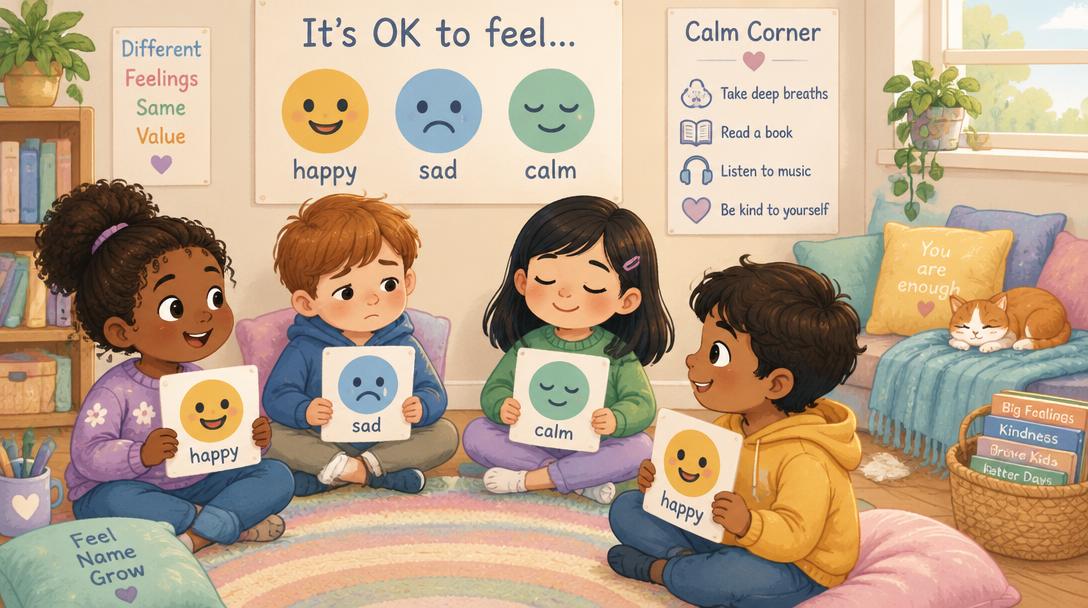
Feelings & calm
Learn the names of feelings and gentle ways to feel calm again.
0 of 5 lessons done
- Lesson 1 · EYFS · 10 min
Naming my feelings
Say the name of a feeling and show it on your face.
Learn: Feelings are messages from our body. Happy, sad, cross, scared and calm are all feelings, and every feeling is allowed. When we can name a feeling, it gets a little smaller and easier to handle.
Try it: Make a happy face, a sad face and a calm face in a mirror. Name each one.
Check: What can you do when you feel cross?
Name it, take slow breaths, and tell a grown-up you trust
Watch and learn
Videos come only from approved education channels and need internet. Use the arrows in the player for more videos from the same channel.
- Lesson 2 · KS1 · 10 min
Belly breathing
Use slow breathing to feel calmer.
Learn: When we are worried, our breathing gets fast. Slow breathing tells the body it is safe. Put a soft toy on your tummy. Breathe in through your nose for four counts and watch it rise. Breathe out slowly for four counts and watch it fall.
Try it: Do five slow belly breaths with a toy on your tummy.
Check: Why does slow breathing help?
It tells your body it is safe so you feel calmer
Watch and learn
Videos come only from approved education channels and need internet. Use the arrows in the player for more videos from the same channel.
- Lesson 3 · KS1 · 15 min
My calm toolbox
Choose three things that help you calm down.
Learn: Different things help different people. Some like a quiet corner, a hug, squeezing a cushion, drawing, music or a walk. Having a toolbox of ideas means you know what to try when big feelings come.
Try it: Draw a toolbox and put three calming ideas inside it.
Check: Name one thing that helps you calm down.
Any safe idea, such as breathing, drawing or a quiet corner
Watch and learn
Videos come only from approved education channels and need internet. Use the arrows in the player for more videos from the same channel.
- Lesson 4 · KS2 · 15 min
Grounding with five senses
Use the 5-4-3-2-1 method to steady worried thoughts.
Learn: Grounding brings your attention back to now. Notice five things you can see, four you can touch, three you can hear, two you can smell and one you can taste. Your brain is busy noticing, so worry has less room.
Try it: Try 5-4-3-2-1 and write down what you noticed.
Check: What does the number 3 stand for in 5-4-3-2-1?
Three things you can hear
Watch and learn
Videos come only from approved education channels and need internet. Use the arrows in the player for more videos from the same channel.
- Lesson 5 · KS2 · 20 min
Feelings and friendships
Explain how to say how you feel kindly and clearly.
Learn: An 'I statement' helps: 'I feel ___ when ___ because ___.' It shares your feeling without blaming. Listening back, without interrupting, shows respect.
Try it: Write two I statements about real moments this week.
Check: Finish the I statement start: 'I feel…'
I feel [feeling] when [what happened] because [why]
Watch and learn
Videos come only from approved education channels and need internet. Use the arrows in the player for more videos from the same channel.